
Yes, we know it’s a long way to come but this is Northumberland, a wholly underappreciated area of the UK, full of natural beauty and history. If you’ve time, you could extend your visit and spend a day or two getting to know the place we still think of as home. We have listed below, and in no particular order, just a few of the places we enjoy most.
Hadrian’s Wall
Possibly the single best known feature of Northumberland and Cumbria is Hadrian’s wall, the wall built on the command of the Roman emperor Hadrian to separate the northernmost part of the Roman empire from the marauding picts.
The Hott is very close to the most scenic parts of Hadrian’s wall at Steel Rigg and Sycamore Gap (the latter pictured above). Don’t leave without seeing these if you can avoid it.
Also, very nearby, we have the Roman forts of Vindolanda (around a mile to the north-west of The Hott) and Housesteads (around 3 miles north-north-east).
English Heritage and the National Trust
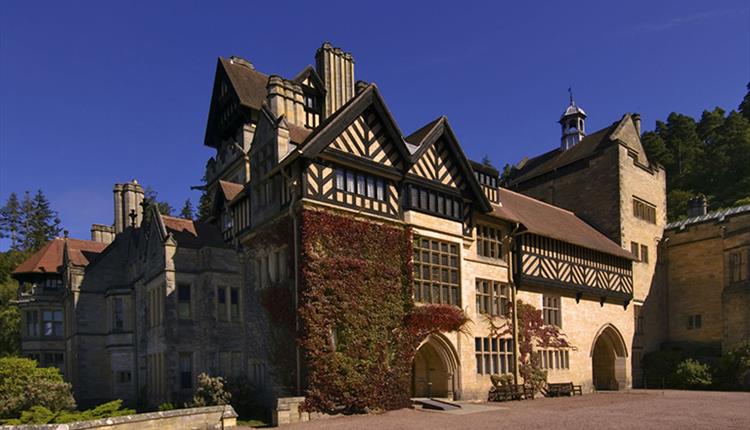
English Heritage and National Trust members may visit Housesteads fort without charge and there are many other notable sites in Northumberland in the care of these organisations.
A particular favourite of ours has always been Cragside near Rothbury, a country house built by Lord Armstrong and the first in England to be lit by electricity.
There’s also Wallington, famous for its dolls’ house collection, its ha-ha, its walled garden and its walks.
The Coast
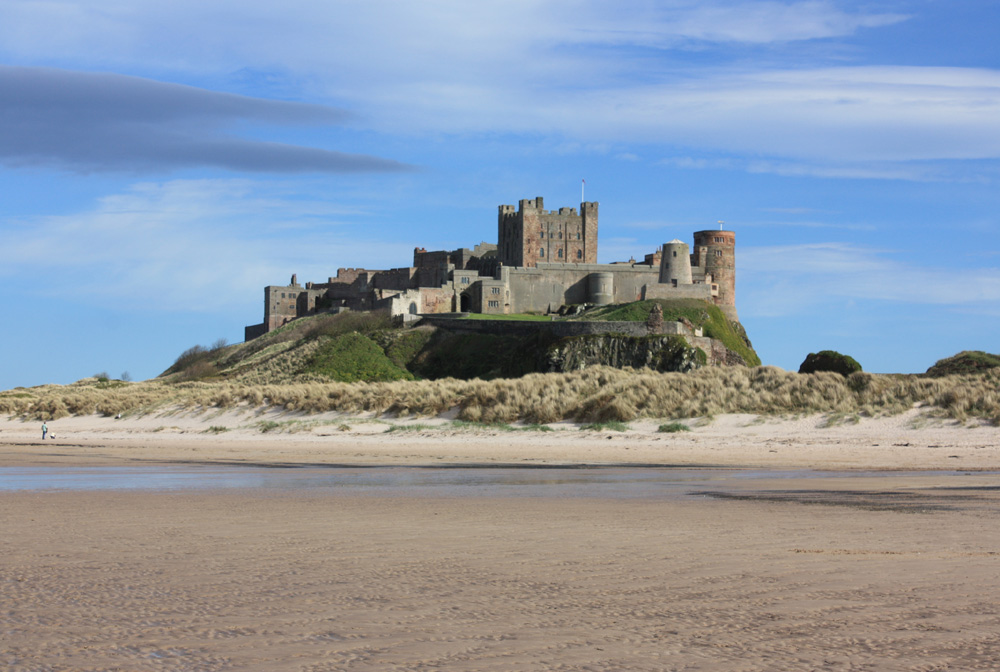
On the coast, there’s Bamburgh Castle (privately held, so NT and EH members will have to pay), which also has connections to the Armstrong family, and another favourite of ours, Dunstanburgh Castle (free to NT and EH members). Dunstanburgh Castle is close to the coastal village of Craster, where you can buy kippers and smoked salmon direct from the Robson smokery.

Lindisfarne and the Farne Islands

Lindisfarne (also known as Holy Island) is an island/peninsular off the Northumberland coast, accessed via a causeway which is submerged at high tide. It is home to Lindisfarne Priory and Lindisfarne Castle, and famous for Lindisfarne mead.
Slightly further out to sea to the south-east of Lindisfarne lie the Farne islands. These are accessible by boat from Seahouses, are managed by the NT and are home to a seal colony and many wild birds including, famously, puffins.
Alnwick

Alnwick is a pretty little town in Northumberland famous for its castle (also privately held) and Treehouse restaurant, which one of our guests had something to do with, apparently ;-).
There’s also an excellent gents’ outfitters shop, which Christopher can recommend without reservation.
Kielder

Keilder, with its forest, reservoir and observatory, is about 40 miles by road from Bardon Mill. Kielder is an area of outstanding beauty and, apropos nothing much, very near the location of Christopher’s mid-70’s camping trip (with the 72nd Newcastle, a scout group based at Dame Allan’s Boys’ School) – that location is now under water (Kielder reservoir) and has been for many years.
Keilder is also at the centre of the largest expanse of dark night sky in the whole of Europe, thanks to minimal light pollution. Night skies across most of rural Northumberland are quite unlike any routinely seen by people in other parts of the UK.
While You’re Here…
If you travel up the eastern route, you’ll pass Durham, a world heritage site famous for its peninsula (a large meander in the River Wear) on which are sited an ancient cathedral and Durham castle. Some of the best views over Durham are from the railway viaduct as you approach the station from the south.
No visit to the North-East is complete without seeing The Angel of the North, a huge sculpture by Antony Gormley which stands just south of Gateshead and is clearly visible from the A1.
And the cities of Newcastle-upon-Tyne and Gateshead are always worth a visit for their culture, history, restaurants, pubs and shopping.
We’ve left comments open on this page so that our northern guests can offer suggestions, for the benefit of our southern guests, to correct our many omissions – and we know we’ve missed plenty. Comments are moderated and will not appear immediately, or at all if we don’t like them ;-).
I believe that Joseph Swan’s own house in Gateshead was the first (anywhere in the world) to be lit by electricity,
Cragside was the second house lit by Swan’s lightbulbs but definitely the first to be lit by hydroelectric power.
Thanks Huw. I stand corrected.